
Embedding AI: what we learned from Jules Love’s work with agencies.
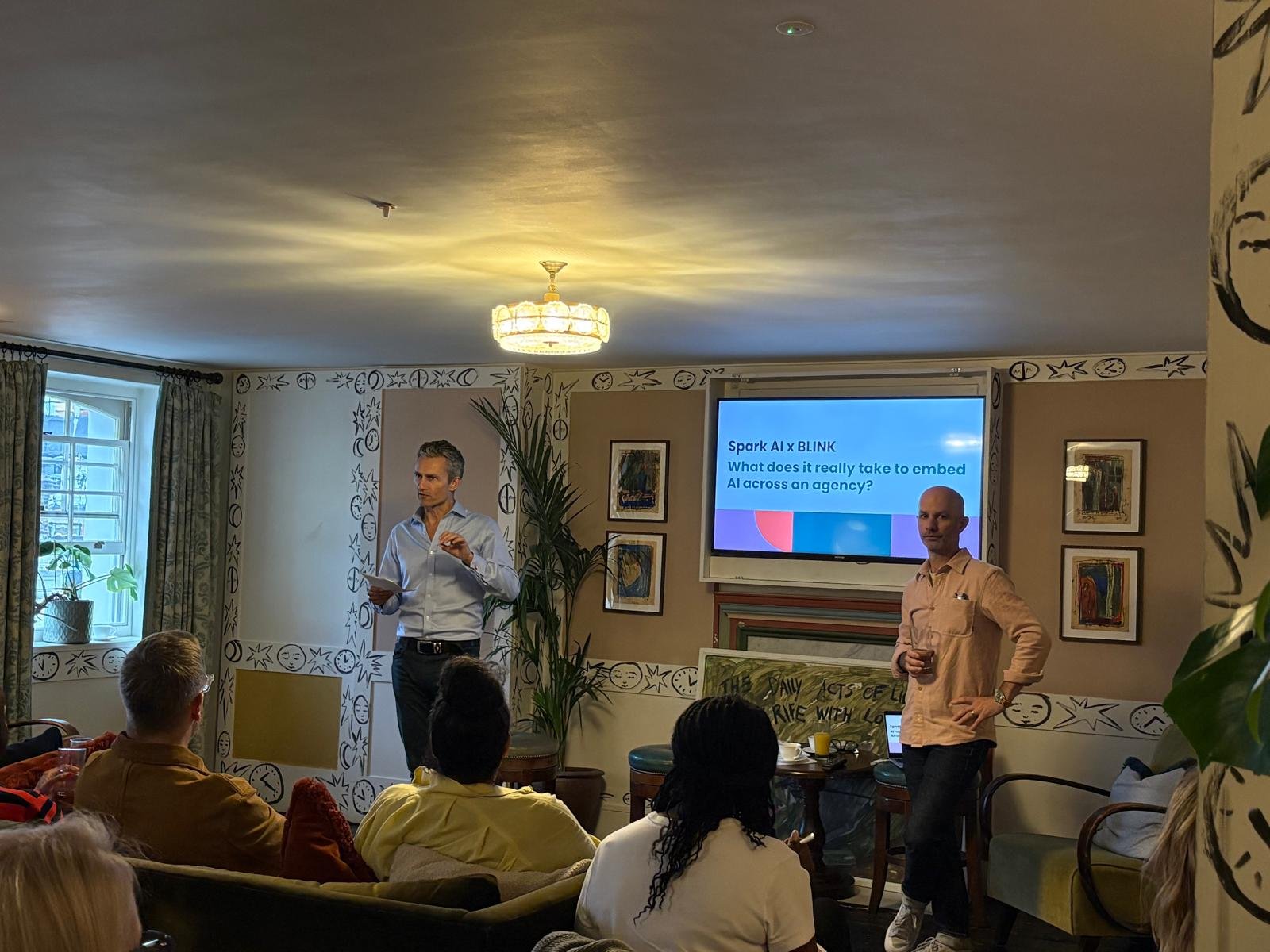
BLINK Founders’ Breakfast, October 2026
The opportunity with AI is to move beyond individual experimentation, to building a shared agency capability.
That was the theme of our latest BLINK founders' breakfast, where Jules Love of Spark AI explained what that actually takes: direction, changes in how people work, useful tools and clear governance.
Here are our notes from the morning.
Start with your business strategy
Your AI priorities should come from your strategy, not from the tools. Jules offered two questions to start with:
What do clients choose you for?
What stops you delivering that consistently?
Use the answers to focus your effort, looking at both how you work internally and how you can create more value for clients.
Think beyond saving time
Efficiency matters, but so do quality, consistency and client value. Jules described three ways to apply AI:
Augmentation: helping people do better work.
Automation: removing repeatable tasks.
Innovation: creating new services and experiences.
An AI plan that only covers automation leaves the other two untouched.
Keep human judgement at the centre
Jules's rule of thumb is "Think, AI, think." Form your own view before involving AI, use it to develop and challenge your thinking, then judge the result yourself.
Clients are buying your expertise and judgement. Passing on an unedited AI output can simply transfer the work to somebody else.
Give people time, direction and ownership
Good intentions aren't enough. People need time, direction and ownership:
Build a short backlog of useful initiatives, give each one an owner and protect time to work on them.
Pair enthusiasts with less confident colleagues, and share what works.
Make AI skills part of development conversations.
Model the behaviour you expect. Leaders go first.
Turn your knowledge into shared tools
Briefs, pitch decks, client feedback and meeting transcripts are all useful context. Organise them so that both people and AI can find and understand them.
Start with shared projects and reusable assistants, then build agents where they solve a clear problem. Show AI examples of good and poor work, and explain the difference.
Be proactive with clients.
Make sure your team understands your AI policy and can explain how you protect data, maintain quality and respect client requirements.
Starting the conversation yourself, rather than waiting to be asked, gives you the chance to talk about value as well as cost.
Review how you charge
Pricing entirely by hours or days has been a risk for some time. But now you might actually be penalised for becoming more efficient. Faster delivery can have real value to a client. Price for it.
And then consider basing your fees on deliverables, packages, subscriptions or outcomes.
As advisors we talk to clients about this all the time. AI has just become a forcing factor.
Don't automate the thinking your client values most
One example we discussed was a copywriting agency that keeps its writing human. It uses AI to improve briefs, prepare research and provide initial feedback. The aim is to give writers more time for the work clients value most.
What’s your version of this?
A practical first step
You don't need a transformation programme to begin. Jules's suggestion:
Choose one recurring workflow
Define what a better result would look like
Give someone ownership and protected time
Review the effect on quality, time and client value
Where an outside view helps
My own reflection: very little of this is about technology. It is about strategy, priorities, ownership, pricing and client conversations. Those are leadership questions. They are also the questions owners find hardest to answer from inside the business.
Three ways in which we as external advisors earn our keep:
Clarity: an honest, outside answer to "what do clients choose you for?"
Focus: help choosing the few initiatives that matter and dropping the rest.
Accountability: someone who asks, a month later, whether the protected time was actually protected.
If you would like to talk any of this through, or you would like to join us at our next founders' breakfast, get in touch (below).